Top Rated History Movies on Pantaflix - Page 410
All Services
Free Services
 Netflix
 Amazon Prime Video
 Apple iTunes
 Apple TV Plus
 Disney Plus
 Google Play Movies
 Paramount Plus
 Hulu
Hulu
 HBO Max
 YouTube
 fuboTV
 Peacock
 Peacock Premium
 Amazon Video
 The Roku Channel
 AMC+
AMC on Demand
AMC+
AMC on Demand
 Kocowa
 Hoopla
 The CW
 Vudu
Vudu
 Starz
Starz
 Showtime
 PBS
PBS
 Pantaflix
 FXNow
FXNow
 Tubi TV
 Kanopy
 Comedy Central
 Crunchyroll
 Microsoft Store
 Redbox
 Sun Nxt
 ABC
ABC
 DIRECTV
 Crackle
 Fandor
 Plex
Plex
Netflix
Amazon Prime Video
Apple iTunes
Apple TV Plus
Disney Plus
Google Play Movies
Paramount Plus
Hulu
HBO Max
YouTube
fuboTV
Peacock
Peacock Premium
Amazon Video
The Roku Channel
AMC+
AMC on Demand
Kocowa
Hoopla
The CW
Vudu
Starz
Showtime
PBS
Pantaflix
FXNow
Tubi TV
Kanopy
Comedy Central
Crunchyroll
Microsoft Store
Redbox
Sun Nxt
ABC
DIRECTV
Crackle
Fandor
Plex

Tales from the Atlantic Beyond
2025
star 10The film is a poignant personal memory quest that begins at the Bay of Diamant, in Martinique, and carries us to 3 continents, to shine light on what it means to be black today in a globally interconnected world, as seen through the eyes of Martinican artist Laurent Valère and his transatlantic dialogs with the black diaspora.APUKUNAPA KUTIMUYNIN - PV
2025
star 10From the shambles, eminences raise to claim what once belonged to them. Amid danger, mystery and adventure protagonists will face their own willingness. Conflict will bring Young Sisa to the center of this story. Together with Nina, Goddess of Fire, they will try to prevent the rupture. But this is not just a story of Gods and mortals. It’s a story of memory, search… and change. Could Gods and Humans ever coexist again in this soil dirtied with ignorance?Spirit Of The Bird
2012
The Last Twins
2025
The Last Twins
2025
star 10The Last Twins is the never-before-told story of an unsung hero of the Holocaust, Erno “Zvi” Spiegel, who risked everything to save dozens of young twins from almost certain death at Auschwitz. Under the shadow of Dr. Josef Mengele’s horrific experiments, Spiegel used his courage, compassion, and ingenuity to shield the most vulnerable—the sets of twins targeted for brutal medical experimentation. Mengele put Spiegel in charge of the young boys, but Spiegel used his position to protect and comfort the children, all of whom had been torn from their families and subjected to inhumane tests under the constant threat of extermination. Through first-hand testimony and exclusive archival material, The Last Twins brings to life the voices of those who survived because of Spiegel’s defiance. It is a testament to resilience, sacrifice, and the power of one person to make a difference, even in humanity’s darkest hour.1984 Death Only Cure
2024
1984 Death Only Cure
2024
star 7When a MIC(Methyl isocyanate) plant operator Bhaskar yadav working was phosgene gas operator room suddenly take a emergency call from main plant and after that everything upside down for UCIL(union carbide india limited)factory and bhopal's people and considering majors accidents.Marginalia
2025
Marginalia
2025
star 10When a young monk gets creative in the scriptorium, things take an unexpected turn as his doodles come to life!Het Grote Offensief
2025
Het Grote Offensief
2025
star 8The two rival Allied commanders, General Eisenhower and Field Marshal Montgomery, clash in a battle of egos and strategic choices, with devastating consequences for the people of Zeeland during the liberation of the Netherlands.Brim
2025
Brim
2025
star 10"Brim" is a trans-generational drama exploring racial trauma, resilience, and legacy, as we follow a family from the 1940s into the 2020s. The narrative navigates the erasure of Blackness and how racial trauma impacts Alzheimer's disease and cognitive decline as the majority American identity reckons with race and privilege and their role in oppressive systems.Visas for Life
2005
Visas for Life
2005
star 6World Wat II broke out shortly after diplomat Chiune Sugihara was assigned to Lithuania. Nazi Germany occupied the western half of Poland and began persecuting the Jews. Lithuania was then annexed by the Soviet Union, and the Japanese consulate was ordered to close. Meanwhile, Jewish refugees who had fled Poland flocked to the Japanese consulate, requesting the issuance of Japanese transit visas. Chiune repeatedly sent telegrams to the Ministry of Foreign Affairs requesting permission to issue visas to the Jewish refugees, but received a final notice that the visas could not be issued. However, with only a month left until the departure deadline, Chiune decided to defy the Ministry of Foreign Affairs' orders and issued visas to the Jewish refugees...Cloak and Claw
2025
Cloak and Claw
2025
star 10Two brothers, ordered by their ill-fallen father, traverse through the cursed wilderness, establishing their past helps develop a newfound bond. All the while a presence lurks behind them...Petro-Melancholie
2023
Petro-Melancholie
2023
Mia Farrow: Shadows and Light
2025
star 6The artistic career of American actress Mia Farrow has been that of a passionate and committed woman who became the embodiment of a special kind of femininity, halfway between innocence and madness.DR2 tema: Skattejagt
2015
Whispering Shadows
2024
Whispering Shadows
2024
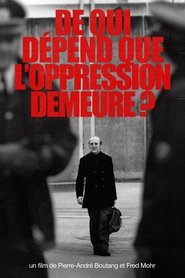
star 10An unsolved mystery. A haunting discovery. Shadows that hide more than darkness. Whispering Shadows—where curiosity could be your undoing. A Short Film by Paradigm ClubDe qui dépend que l’oppression demeure ?
1975
star 10On May 21, 1975, the trial of the members of the Red Army Faction (also known as the Baader-Meinstein Gang) began. Four members appeared before the Stuttgart court to answer for the attacks that had been raging for five years in the young Federal Republic of Germany. The documentary, whose title is borrowed from Berthold Brecht's In Praise of Dialectics, recounts the conditions of the trials and detention of the Baader-Meinstein Gang members and the disqualification of Klaus Croissant as their lawyer.They Chose Algeria
2007
They Chose Algeria
2007
star 10Many of them participated in the struggle for Algerian independence. There are "those who believed in heaven", priests, Christians committed against torture, friends of the "natives", there are "those who did not believe in it", communist activists, students, progressive intellectuals, others remained in this country because they could not imagine living anywhere other than in this land of all passions. They are European and chose to stay in Algeria after independence, most of them opted for Algerian nationality. The film is another vision of the history of Algeria from the end of the fifties to the present day, told by these Europeans filmed at home, or in the context of their activities, illustrated by unpublished archive documents.Liberation Diaries
2025
Liberation Diaries
2025
star 8The end of World War II brings Europe a new political system, reshapes national and personal identities. Three women from Milan, Paris and Berlin report on the days of liberation in their diaries. Their personal stories expand the historical picture and make LIBERATION DIARIES a chronicle of female self-empowerment, resistance and resilience.Muñiz, The Argentinian In The Algerian Revolution
2020
star 10Roberto Muniz, nicknamed "Mahmoud the Argentinian," was a revolutionary fighter who joined the National Liberation Army in 1959 to support the Algerian cause in the war of independence against France. He joined a clandestine group that manufactured weapons and ammunition to be transported to Algeria to support the revolution that began in 1954. After the war, the Algerian government invited the mujahid to stay, an offer he accepted to begin a new life as an employee of Sonnelgaz and a member of the General Union of Algerian Workers (UGTA), accompanied by his wife Alfonsa, a textile union activist who came from Argentina to join this North African adventure.Bernadette of Lourdes : the musical in cinema
2025
star 7Bernadette Soubirous, just 14 years old, goes by the river near the Massabielle cave. It is there that, for the first time, a “lady dressed in white” appears to her. Accused of lying, Bernadette’s revelation initially provokes mistrust and tensions in her family, drawing the wrath of civil and ecclesiastical authorities. The rumor spreads. Pilgrims begin to converge. Lourdes goes down in History.